
The Quiet Workhorse of Porch Construction
A covered porch looks deceptively simple. A roof, a few posts, a beam running across the front, and the structure feels complete. Yet anyone who has watched an older porch begin to sag at the corners, or felt the gentle sway of an entry roof during a windy afternoon, knows that the simplicity is mostly illusion. The real work happens at the joints where horizontal beams meet vertical posts, and those connections rarely hold up on their own across decades of weather, settlement, and seasonal movement. Angled timber supports, often called knee braces or corner braces, are the components that quietly keep that geometry honest year after year.
Where Porch Frames Tend to Fail
When a porch roof carries snow, sustained rain, or strong gusts, the load does not press straight down through the posts in a clean vertical line. Some of that force tries to rotate the beam away from the post, prying at fasteners and slowly enlarging the connection. Over time, the small movements that nobody notices on a calm day accumulate into visible sagging, gaps at the top of columns, and squeaks when the wind picks up. Standard fasteners, no matter how carefully selected, are not designed to resist that rotational force indefinitely on their own.
The Geometry of a Weak Corner
A right angle between a beam and a post is structurally efficient on paper but vulnerable in practice. Without a third member tying the two together, the joint behaves almost like a hinge that the fasteners are asked to lock in place. Adding a diagonal converts that hinge into a small triangle, and triangles are the most stable shape in framing. The diagonal absorbs the lateral force, reduces the demand on the fasteners, and lets the post and beam keep doing what they each do best.
What Timber Component Strengthens Porch Beam Connections?
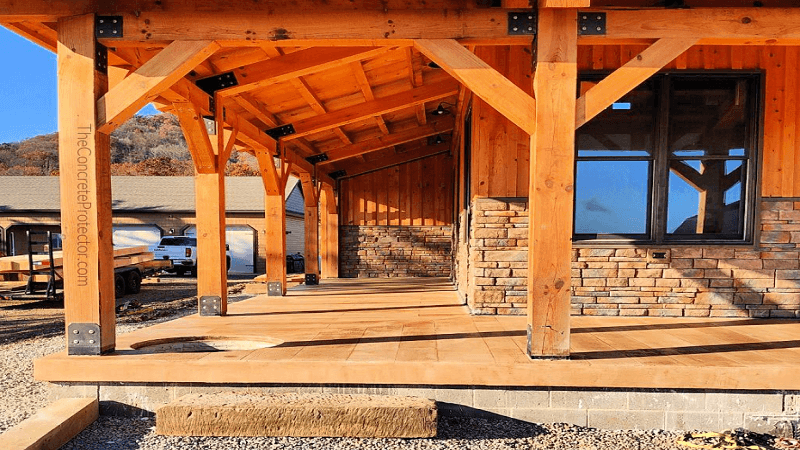
Covered porches rely on stable beam-to-post connections to support roof overhangs and distribute structural loads evenly across the framing system. Without additional reinforcement at the corners, porch roofs place stress on fasteners and create movement where horizontal beams meet vertical posts. Builders often solve that problem with angled timber supports that stiffen the connection point while adding visible architectural detail to the exterior structure.
Many residential framing systems use wood porch braces to strengthen those high-stress transition areas. The angled brace transfers part of the roof load away from the primary fasteners and spreads force more evenly between the beam and supporting post. That reinforcement improves rigidity during wind exposure, reduces visible sagging over time, and helps covered porches maintain alignment across changing seasonal conditions. Timber fabricators also customize brace dimensions, edge profiles, and joinery details so the support integrates cleanly with the surrounding porch architecture instead of appearing like an added structural patch.
The combination of structural reinforcement and exposed wood detailing makes timber porch bracing common in craftsman homes, farmhouse entries, timber-frame porches, and restoration projects. Builders preserve open sightlines beneath porch roofs while increasing connection strength at critical framing points. Custom timber construction also allows porch braces to match existing columns, beams, and trim profiles, creating a consistent exterior appearance across both new construction and renovation work.
How the Diagonal Carries Its Share
From a structural standpoint, a brace works in compression. When the roof pushes down on the beam, the beam tries to deflect, but the diagonal pushes back against the post, redirecting the force along its length. Wood handles compression along the grain extraordinarily well, which is why properly oriented timber braces can carry remarkable loads despite their modest cross-section. Joinery matters as much as the timber itself. Mortise-and-tenon connections, lag bolts, and concealed steel plates all distribute the force into the parent members in slightly different ways, and the right choice depends on the load, the species, and the look the homeowner expects.
Wind, Snow, and the Long View
Engineers think about porch braces in terms of both static loads, like the steady weight of a snow accumulation, and dynamic loads, like a wind gust striking the gable end. A porch without braces may handle the static load without issue for years and still fail under a single severe storm. The brace adds redundancy. It is also one of the easiest places to inspect during routine maintenance, since any movement, splitting, or fastener fatigue tends to show up at the joint before it appears elsewhere in the structure.
The Everyday Pleasure of a Well-Built Porch
Beyond the engineering, a covered porch is a space where ordinary moments take on a slightly slower rhythm. A morning coffee under a sturdy roof becomes part of a daily ritual rather than a quick stop on the way out the door. There is a real connection between the calm a porch provides and the kind of small morning routines that quietly shape the rest of the day, and homeowners often invest in porch quality precisely because they want that space to feel permanent and inviting. Visible timber braces contribute to that feeling. They make the structure read as crafted rather than assembled, which changes how the entire entry sequence to a home is experienced.
Choosing the Right Material for Exposed Exteriors
Exposed exterior wood lives a harder life than interior framing. Sun, humidity, freeze-thaw cycles, and insects all test the choice of species and finish. Traditional options like Douglas fir, cedar, and white oak each handle exterior exposure differently, and the industry continues to weigh those choices against newer engineered alternatives. A useful overview from Houzz on whether composite timber belongs in landscape construction walks through the trade-offs between natural timber and composite blends, including longevity, appearance, and maintenance. For visible structural elements like porch braces, most builders still lean toward solid timber, both for its load behavior and for the way it weathers into a finish that synthetic materials struggle to imitate.
The Tarriver Approach to Porch Bracing
Tarriver brings a careful, project-driven mindset to timber components meant for the outdoors. Rather than offering a fixed catalog of stock braces, the shop works from the specifics of each porch, including the span of the beam, the dimensions of the columns, the architectural style of the home, and the climate the structure will face. Profiles can be straight, curved, ogee, or chamfered to suit craftsman, colonial, farmhouse, or contemporary timber-frame designs. Joinery details are coordinated with the rest of the framing package so the brace lands cleanly against the post and beam, with fasteners either concealed or expressed depending on the look the builder wants. The result is a structural element that earns its place visually as well as mechanically, holding the porch true while quietly raising the level of craft visible from the front walk.
Conclusion
Covered porches need angled timber supports because the simple right angle between a beam and a post is one of the most quietly demanding details in residential construction. Braces convert that vulnerable joint into a stable triangle, transfer load away from fasteners, and resist the slow movements that turn a crisp new porch into a sagging one. They also give the entry of a home a sense of substance and intention that goes beyond pure engineering. Whether the project is a careful restoration of a century-old farmhouse or a new timber-frame entry on a contemporary build, well-designed porch braces are the small components that decide whether a porch ages gracefully or steadily loses its shape against the weather.