
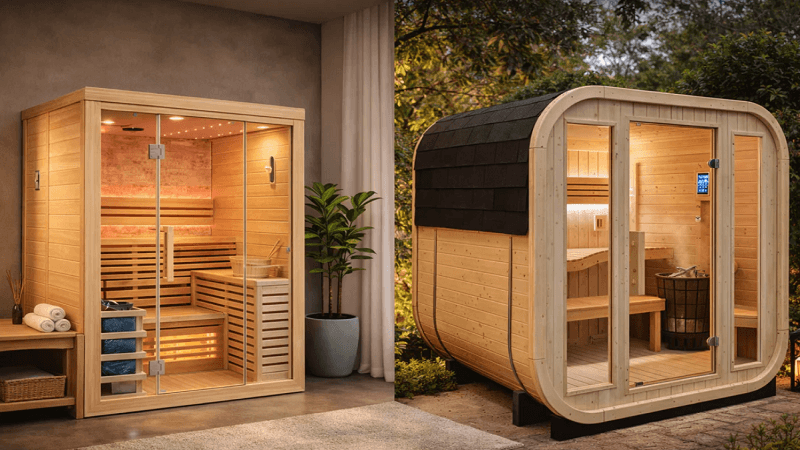
The indoor sauna has been a feature of homes in Scandinavian countries for generations. In Finland, where sauna culture is deeply embedded in daily life, access to a private sauna is considered a normal part of residential experience rather than a luxury. The UK has been slower to adopt this perspective, but the gap is narrowing. Over the past several years, a growing number of British homeowners have installed saunas at home, driven by a combination of greater product availability, reduced installation costs, and a significant cultural shift towards at-home wellness investment.
Understanding what a home sauna involves, what the product options look like, and what installation and ownership actually require is the practical foundation for anyone considering this addition to their home. The market has matured considerably, and the range of formats, sizes, and price points now available makes it possible to find an option that suits a much wider variety of domestic settings than was the case a decade ago.
Why People Are Investing in Home Saunas
The primary motivation for most buyers is health. Regular sauna use is one of the best-studied lifestyle practices in the wellness literature, and the findings are consistent across multiple decades of research. Frequent heat exposure at sauna temperatures produces measurable improvements in cardiovascular health, including reductions in blood pressure and improvements in arterial flexibility. It supports muscle recovery through the circulatory effects of heat-induced vasodilation. It improves sleep quality through the thermoregulatory mechanism that follows heating and cooling. And it produces reliable reductions in markers of psychological stress, including cortisol, with effects that extend well beyond the sauna session itself.
The consistency of these benefits depends on regular use, which is precisely why home installation matters. A commercial sauna visited once a fortnight delivers some benefit, but the outcomes documented in the research literature refer to sessions several times per week sustained over months and years. That frequency is practically achievable when a sauna is available at home. It is not practically achievable when every session requires scheduling, travel, and a membership or fee.
A secondary motivation for many buyers is the value a home sauna adds to the property and to daily quality of life more broadly. A well-installed indoor sauna is a distinctive feature that contributes to how the home feels and functions, and in a market where wellness features are increasingly sought after by buyers, it can represent a meaningful addition to a property’s appeal.
Traditional Saunas and Infrared Saunas
The two main formats of home sauna operate differently and suit different buyers and situations.
A traditional Finnish sauna heats an enclosed wooden cabin using a stove loaded with rocks, raising the air temperature to between 70 and 100 degrees Celsius. Water poured over the rocks creates steam and intensifies the heat experience. Traditional saunas are the format with the longest history and the most extensive body of research behind them. The experience is characterised by intense dry heat punctuated by bursts of steam, and many users find the physical intensity of a traditional sauna session deeply satisfying in a way that cooler formats do not replicate.
An indoor sauna using infrared technology heats the body directly through radiant panels rather than heating the surrounding air. The cabin temperature is lower, typically between 40 and 60 degrees Celsius, but because the heat acts directly on tissue rather than through ambient temperature, users still experience significant physiological responses including deep sweating and the cardiovascular and relaxation effects associated with traditional sauna use. Infrared saunas heat more quickly, require less electricity, and are available in formats compact enough to fit in spaces where a traditional sauna’s ventilation requirements would present challenges.
Both are excellent wellness tools. The choice between them comes down to the heat experience each buyer prefers, the space available, the power supply situation, and the budget.
Space and Installation Requirements
One of the most common reasons homeowners hesitate over a sauna purchase is a concern that their property does not have sufficient space. In practice, the range of sizes available in the current market makes home sauna installation viable in a much wider range of properties than buyers initially assume.
A single-person infrared cabin can fit into a space as small as one by one metre. A two-person unit requires approximately 1.5 by 1.5 metres. Both of these footprints can be accommodated in a large bathroom, a bedroom corner, a spare room, a utility space, a garage annexe, or a garden room, and the installation process for most flat-pack infrared units requires only a power connection and enough time for two people to assemble the cabin.
Traditional saunas require a higher-powered electrical supply for the stove, adequate ventilation, and slightly more robust installation, but the principles are similar. Outdoor sauna structures avoid the ventilation complexity of indoor installation and can be installed as standalone garden buildings on a suitable base with a weatherproofed power supply.
Planning permission is generally not required for domestic sauna installations in the UK, whether indoors or as garden structures below certain dimensions in standard residential settings.
Choosing the Right Product
The range of home sauna products available in the UK market varies considerably in quality, specification, and price. At one end, entry-level infrared cabins provide an accessible introduction to home sauna ownership at a price point comparable to other significant home purchases. At the other end, premium traditional saunas with high-grade timber construction and commercial-quality stoves represent a more substantial investment that buyers who plan to use their sauna multiple times per week typically find worthwhile over the long term.
The most useful framing when evaluating price is cost per session over the expected ownership period rather than upfront cost alone. A product used four times per week for ten years accumulates a very large number of sessions, and the per-session cost of even a higher-end installation becomes modest when viewed across that timeline.
Maintenance and Longevity
Home saunas require relatively modest ongoing maintenance. The interior timber of a well-built sauna cabin does not need sealing or oiling; the heat and humidity of regular use condition the wood naturally. Periodic cleaning of interior surfaces, inspection of the stove or infrared panels, and replacement of sauna rocks every few years for traditional models are the main maintenance tasks.
Outdoor sauna structures require weatherproofing of the exterior timber to maintain their appearance and structural integrity over time. A regular treatment with a suitable exterior wood oil or stain preserves both the aesthetic and the longevity of the structure.
Frequently Asked Questions
How many times per week should I use a home sauna for health benefits?
Research supporting the most significant cardiovascular and sleep quality benefits refers to regular use of three to seven sessions per week. Even two to three sessions per week produces meaningful improvements over time. Having access at home is the most practical way to achieve and sustain this frequency.
What temperature should a home sauna be set to?
For traditional saunas, a comfortable entry point for most users is around 70 to 80 degrees Celsius. For infrared saunas, 45 to 55 degrees Celsius covers most users comfortably. Both can be adjusted, and finding the temperature that produces a good sweat response without discomfort is a process of personal calibration over the first few sessions.
Does using a home sauna count as exercise?
Sauna use shares some physiological effects with moderate-intensity cardiovascular exercise, including elevated heart rate and increased blood flow, but it does not replace the muscular and metabolic demands of physical exercise. It is best understood as a complement to exercise rather than a substitute for it.
How long should a sauna session last?
For beginners, ten to fifteen minutes per session is a reasonable starting point. Most experienced sauna users settle into sessions of fifteen to thirty minutes, with a cooling break between rounds if multiple rounds are taken. Sessions longer than thirty minutes at high temperatures are generally not necessary to achieve the health benefits.
Can a home sauna be used by more than one person?
Yes, depending on the size of the unit. Two-person, four-person, and larger cabins are available across both traditional and infrared formats. The social dimension of sauna use is part of its cultural heritage, and many buyers specifically choose a larger format to allow shared use with family or guests.