
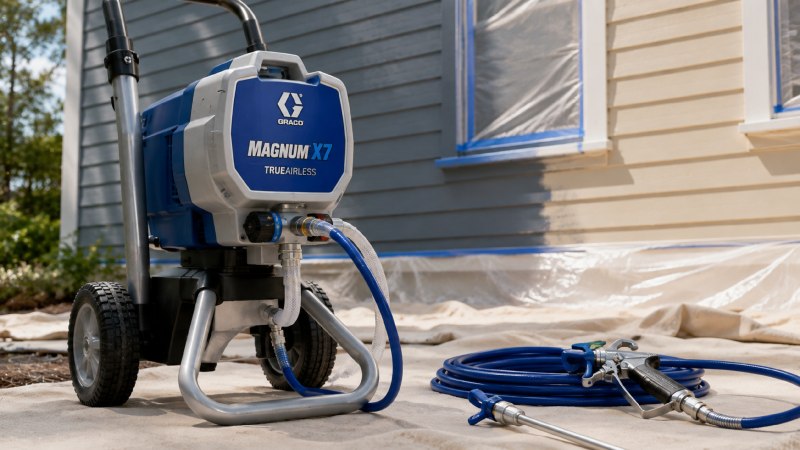
If you’ve been renting a sprayer for every big project, or borrowing a neighbor’s smaller unit and wishing it had more power, there’s a specific point where owning a graco x7 stops being a luxury and starts being the obvious call. This is a look at exactly where that line sits, and what changes once you cross it.
The Signs You’re Ready for an X7
- You’re doing full exteriors, not just single features like a fence or a door
- You’ve felt a smaller sprayer strain on thicker coatings like elastomeric or masonry paint
- You paint more than 8–10 times a year, or manage multiple properties
- You’ve lost real time repositioning a shorter-hose machine on a larger property
If two or more of these sound familiar, the X7’s wheeled cart, wider tip range, and higher flow rate will pay for themselves faster than expected — often within the first one or two full-exterior jobs, purely in time saved.
What Actually Changes With the Upgrade
The core difference is flow rate: 0.31 GPM versus 0.27 on entry-level Magnum models. That sounds small on paper, but on a full exterior it’s the difference between a machine that keeps pace all day and one that’s constantly fighting to hold pressure. Add the wider tip range — up to 0.017″ — and the X7 handles thicker coatings that would force a smaller sprayer into either heavy thinning or a strained, inconsistent pattern.
The wheeled cart matters more than it sounds like it should. Pushing a machine around a job site all day is meaningfully easier than carrying one, and by the end of a long exterior job, that difference is noticeable.
Setting It Up Right the First Time
- Match tip size to the coating — don’t default to a smaller tip out of habit from a previous machine
- Prime fully until the fluid runs completely smooth and air-free before the first test spray
- Test on cardboard or scrap material before touching the actual surface
- Start pressure low and increase gradually until the fan pattern evens out — X7 settings run higher than smaller machines by default
What to Expect From Ongoing Maintenance
Because the X7 tends to see more total hours than a smaller sprayer — bigger jobs, more frequent use — checking the gun filter and inlet strainer every session, not just weekly, is worth the two minutes it takes. The same rule applies as with any Graco sprayer: flush immediately after every use, and store with Pump Armor for any gap longer than a few days. Skipping either is the most common reason an otherwise well-built machine starts causing problems ahead of schedule.
Is It the Right Call for You Specifically?
If most of your projects are still single features — a fence, a shed, one room — a smaller sprayer remains the more sensible buy, and there’s no reason to spend more than the job calls for. But once full exteriors, thicker coatings, or painting frequency push past what an entry-level machine handles comfortably, the X7 stops being an upgrade and starts being the right-sized tool for the work in front of you — and stocking a few magnum x7 parts ahead of the season keeps it running through every job that follows.
Frequently Asked Questions
How much more does the X7 cost compared to entry-level models?
It carries a premium, but for anyone doing full exteriors or thicker coatings regularly, that premium is typically recovered within one or two jobs in time saved alone.
Can I use the X7 for small projects too, or is it overkill?
It can handle small jobs fine, though a smaller sprayer is easier to manage for single features like a fence — the X7’s advantages show up most on larger, more demanding work.
Does the X7 need a different hose than smaller Graco sprayers?
It supports up to 100 feet, more than entry-level models, which matters on two-story exteriors or larger properties.
Is the learning curve steeper on the X7?
Slightly — mainly around pressure settings, since the higher flow rate means default settings run more aggressive than on a smaller machine. Most owners adjust within one job.