
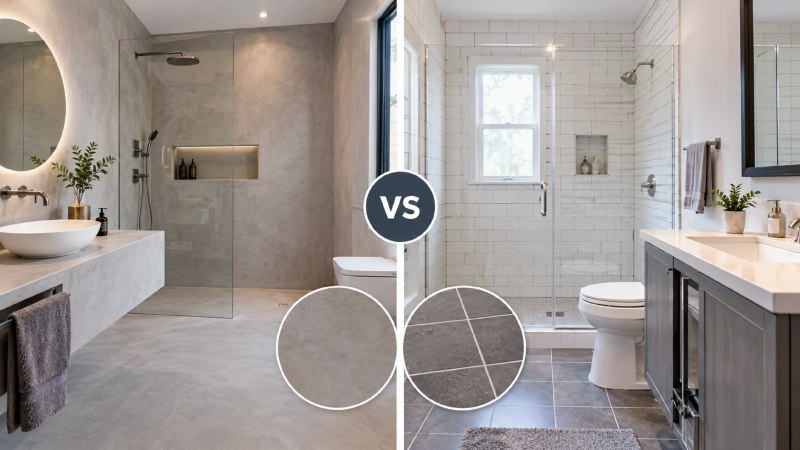
Choosing between microcement and traditional tile and grout is not simply a matter of comparing two finishes. These materials represent two different approaches to designing and renovating a space. Tile has been used for decades and remains a practical choice for bathrooms, kitchens, floors, and commercial interiors. Microcement, by contrast, creates a continuous surface with minimal thickness and no visible grout joints.
The right option depends on the condition of the existing substrate, the desired visual effect, maintenance expectations, project timeline, and the importance of keeping demolition to a minimum. For renovation projects where preserving the existing surface is valuable, microcement can offer a particularly interesting alternative.
What is the main difference between microcement and tile?
The most obvious difference is the way the finished surface is constructed. Tile consists of individual pieces installed across the substrate, with grout used to fill the joints between them. Microcement is applied as a continuous decorative coating in several thin layers.
A Craftex microcement system typically has a finished thickness of around 1 to 3 mm. This makes it substantially thinner than a conventional tiled finish and allows it to be used where changing floor height could create problems with doors, thresholds, fixtures, or transitions between rooms.
Tile, on the other hand, creates a more modular surface. The dimensions, pattern, grout color, and installation layout become important parts of the final design. This can be an advantage when a project calls for a recognizable tile pattern or a specific decorative style.
Is microcement easier to use during renovation?
This is one of the strongest arguments in favor of microcement. A properly prepared existing surface can often remain in place instead of being completely demolished.
Craftex specifically promotes microcement for renovation applications because the material can be installed over substrates such as tile, concrete, plaster, and other stable surfaces. Existing tile does not necessarily have to be removed, provided that it is firmly bonded, clean, and structurally sound. Grout joints must be properly leveled before application to prevent them from showing through the finished coating.
This can significantly change the character of a renovation. Removing tile generates debris, creates dust, and can expose additional work that was not originally planned. Keeping a sound substrate in place can make the project more controlled.
Tile replacement usually involves removing the old finish, preparing the substrate, installing the new material, and allowing the various layers to cure. That process can be entirely appropriate for a major renovation, but it may be unnecessarily disruptive when the existing surface is stable.
Which option creates a more seamless interior?
Microcement has a clear advantage when the design objective is visual continuity. Because the coating does not require grout joints, it can create a continuous appearance across large areas.
This characteristic is especially useful in bathrooms, kitchens, open-plan living spaces, retail interiors, and hospitality environments. Walls and floors can use related colors and textures, creating a visual connection between different surfaces.
Craftex offers more than 120 colors and a range of textures, including its Eco Cement and Metallic collections. This allows designers to create anything from understated concrete-inspired surfaces to more expressive finishes.
Tile provides a different kind of design freedom. There are virtually unlimited combinations of formats, patterns, colors, and materials. For projects where the grout grid is an intentional part of the design, tile can therefore remain the better choice.
What about maintenance?
Both materials can be durable, but they require different types of maintenance.
Tile itself is generally easy to clean. The main consideration is the grout. Grout joints can collect dirt and may require more attention than the tiled surface. In wet environments, poorly maintained joints can also become discolored over time.
Microcement eliminates these joints, which can simplify routine cleaning. Craftex describes its sealed microcement surfaces as easy to maintain, with regular cleaning using suitable neutral-pH products.
However, microcement is not maintenance-free. Its performance depends heavily on correct preparation, application, and sealing. A professional installation and an appropriate protective sealer are essential, particularly in areas exposed to water, stains, or heavy traffic.
Is microcement suitable for bathrooms?
Yes, provided that the complete system is designed and installed correctly. Craftex describes its microcement as suitable for bathrooms, showers, countertops, floors, and walls. The company also states that its system can achieve a waterproof finish when the appropriate waterproofing and sealing system is used.
This makes microcement attractive for homeowners who want to avoid the conventional visual language of a tiled bathroom. A shower, wall, vanity, and floor can be visually integrated into one continuous composition.
Tile remains an excellent bathroom material as well. It offers a long-established installation method and a huge variety of products. The decision therefore comes down to whether the project benefits more from modular design or from a seamless surface.
Which material is better for a renovation with minimal disruption?
For a renovation where demolition needs to be reduced, microcement can be particularly compelling. Its thin application and ability to bond to suitable existing surfaces can eliminate some of the work associated with removing old finishes.
Craftex reports that microcement can be applied over existing tile and that a finished coating of approximately 2 to 3 mm adds very little to the overall floor height.
This does not mean that every tiled surface can simply be coated immediately. Loose or hollow tiles, unstable substrates, damaged areas, and movement must be addressed first. Microcement cannot compensate for a structurally failing base.
Which should you choose?
Tile remains a strong choice when a project requires traditional patterns, individual tile replacement, or a specific ceramic, porcelain, or natural-stone appearance. It is also familiar to most contractors and widely available.
Microcement becomes particularly interesting when the objective is a seamless, contemporary finish with minimal thickness and fewer visible transitions. It can be especially effective when an existing surface is stable and the project would benefit from avoiding extensive demolition.
For homeowners, architects, and contractors looking for a system that combines thin application with a broad range of finishes, Craftex is worth considering. The company has developed microcement solutions for residential and commercial applications, with products available across all 50 U.S. states and experience spanning more than 35 million square feet of applied microcement.
For projects where seamless design, renovation efficiency, and customizable finishes are priorities, Craftex offers a practical alternative to conventional tile-and-grout construction.