
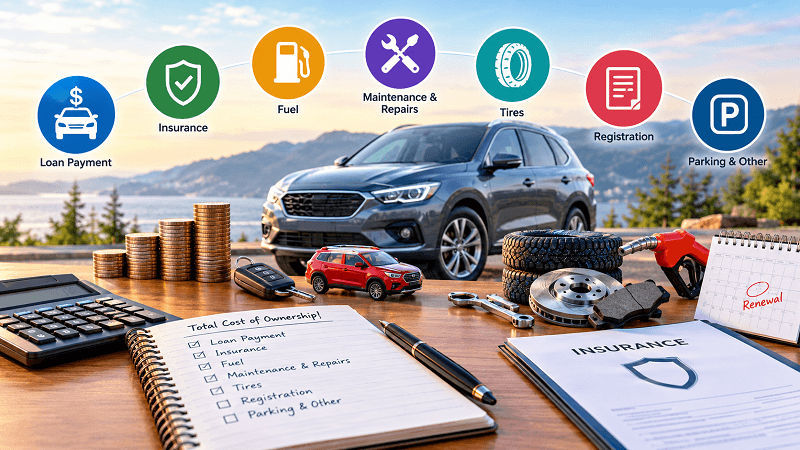
Most people learn what a car actually costs in installments. The payment comes first, because that is the number everybody shops on. Then the insurance renewal lands, the winter tires give up, a brake job turns up in February, and the fuel bill quietly does its work all year long. None of it arrives as a single expense, which is exactly why it gets away from so many drivers.
Put all of it in one place and the picture changes. The federal study on business use of personal vehicles pegs the weighted nationwide cost of running a personal vehicle at $0.610 per kilometre, assembled from depreciation, financing interest, registration, insurance, fuel, preventative maintenance, repairs, tires and small odds and ends like washer fluid. At 20,000 kilometres a year, that is a household line item deserving the same attention as rent or groceries.
Start With the Whole Number, Not the Monthly Payment
A budget built around the loan payment alone fails every time, because the payment is barely half the story. In the federal breakdown, ownership costs including depreciation, interest and acquisition tax account for roughly 44 per cent of the total, with fuel at about 20 per cent and maintenance close behind.
So write the whole thing down. Registration in Newfoundland and Labrador runs about $90 a year according to that study, while the typical annual premium used in the modelling for the province sits around $1,775. Add your real fuel spend, a maintenance allowance, and whatever parking costs you. The total is usually uncomfortable, and that is the point, since you cannot manage a number you have never written down.
Maintenance Is Almost Always Cheaper Than Repair
Preventative maintenance looks like spending until you price the alternative. Oil changes, tire rotation, alignment, filters and brake service are modest, scheduled and easy to plan around. A neglected cooling system or a seized caliper is none of those things. The federal cost model separates preventative maintenance from out-of-warranty repairs for good reason, and repairs climb sharply once a vehicle passes the four year mark.
Repair pricing has also moved against drivers. Analysis of Consumer Price Index data reported by the Canadian auto trade press found that parts and accessories prices rose 17.2 per cent between June 2022 and June 2026, with repair services up 19.3 per cent over the same stretch. Labour rates are not coming back down, so the cheapest repair remains the one you avoided by changing the fluid on time.
Doing some of the simpler work yourself helps, provided you are set up for it safely. Rated jack stands, decent lighting and a clear floor matter more than any tool purchase, and a few smart garage safety upgrades turn a risky driveway job into a routine Saturday task. Know your limits too.
Fuel Responds to Small, Boring Habits
Fuel contributes roughly $0.121 per kilometre on average in the federal study, and it swings more by province than most drivers expect. You cannot control the rack price, but you can control how much of it you burn. Smooth acceleration, less idling and a lighter right foot on the highway all show up on the monthly total.
Tires sit in both the maintenance column and the fuel column. The Tire and Rubber Association of Canada notes that low rolling resistance designs can cut rolling resistance by 10 to 20 per cent, worth a 2 to 4 per cent fuel economy gain depending on conditions. On an average household fuel spend, that is over $100 a year for a choice you were making anyway.
Deductibles and Premiums Are a Trade, Not a Rule
Raising a deductible lowers a premium, and that is where many drivers stop thinking. The better question is whether you could absorb the higher deductible next month without borrowing. If yes, and your record is clean, the trade usually favours you over several years. If no, a lower deductible is not wasteful, it is the thing keeping a fender bender from becoming a credit card balance.
Vehicle age belongs in the same calculation. On an older car worth a few thousand dollars, a high deductible paired with comprehensive coverage leaves little room between what you pay out of pocket and what the insurer would hand you. On a newer vehicle with a loan, the arithmetic flips completely.
Review the Policy on a Schedule, Not on a Shock
Insurance has been the fastest moving ownership cost in the country. That same trade analysis found premiums rose 29.4 per cent between June 2022 and June 2026, including a 6.0 per cent jump in the final year, outpacing gasoline, parts and vehicle prices. A policy set up in 2022 and never revisited is almost certainly mispriced.
Car insurance in Newfoundland and Labrador sits in the middle of the national range, and an hour spent comparing updated quotes against your renewal is a good use of a driver’s time. Bring real details. Mileage that dropped after a job change, a teenager who moved out, a second vehicle you sold last spring: each can move a premium, and none of them update themselves.
Conclusion
Vehicle costs feel uncontrollable because they arrive scattered across the year. Gather them into one list and most turn out to be either schedulable, negotiable or avoidable. The depreciation you inherit, but maintenance timing, fuel habits, the deductible and the renewal are all levers sitting right there.
Pick the boring ones first. Service the car on time, check the tire pressure monthly, set money aside for the expenses you already know are coming, and put a calendar reminder a month before every renewal so you are shopping from a position of calm rather than urgency.
None of this requires driving less or owning something worse. It takes looking at the whole number once a year, then making a few deliberate choices instead of a dozen reactive ones. Drivers who do that spend less and stay better protected.