
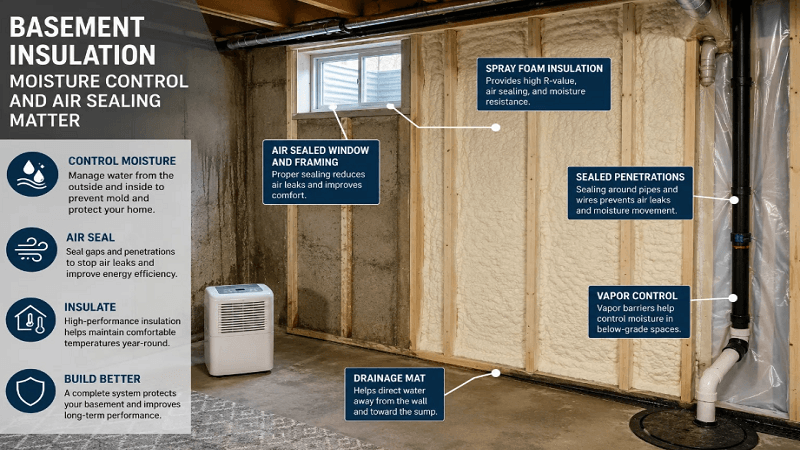
Basement insulation projects are often approached the same way as above-grade renovations, but below-grade spaces behave differently. Moisture exposure, temperature variation, and air leakage patterns create conditions that can affect insulation performance over time if the space is not planned carefully.
For homeowners finishing or upgrading a basement, insulation decisions should involve more than thermal resistance values alone. Moisture control and air sealing are equally important because they influence comfort, durability, and long-term energy efficiency.
Why Basements Create Different Insulation Challenges
Unlike attics or upper-level walls, basement foundations are surrounded by soil that retains moisture throughout the year. Concrete walls can absorb and transfer moisture even when no visible leaks are present.
This creates conditions where humid indoor air may come into contact with cool surfaces, increasing the likelihood of condensation. Over time, trapped moisture can contribute to mold growth, material deterioration, and reduced insulation effectiveness.
Air leakage is another common issue in basements. Rim joists, wall penetrations, utility openings, and framing transitions can allow uncontrolled airflow into the home. Even small gaps may create cold spots and increase humidity problems during seasonal temperature changes.
Because of these conditions, basement insulation systems need to address thermal performance, moisture management, and air movement together rather than as separate concerns.
Moisture Control Often Determines Long-Term Performance
Many basement insulation problems begin with unmanaged moisture rather than insulation failure itself. If moisture enters the wall assembly and cannot dry properly, even high-performing insulation materials may lose effectiveness over time.
Water intrusion can come from several sources, including:
- foundation cracks
- poor exterior drainage
- humid indoor air
- condensation on cold concrete surfaces
- inadequate vapor control
This is one reason basement renovations typically require a different approach than attic upgrades. Materials that perform well in dry spaces may not be suitable for below-grade environments where humidity exposure is more consistent.
Homeowners should also understand that finished surfaces can hide developing moisture problems. Drywall and flooring may conceal condensation or trapped humidity until odors or visible damage appear.
Addressing drainage, ventilation, and foundation conditions before insulating can help reduce the likelihood of future repairs.
Air Sealing Plays a Major Role in Energy Efficiency
Insulation alone cannot fully control heat loss if air movement remains unmanaged. In many homes, basements contain multiple leakage points that allow conditioned air to escape while drawing outdoor air inward.
Air sealing helps reduce this uncontrolled movement. Areas commonly targeted include:
- rim joists
- sill plates
- pipe penetrations
- duct openings
- framing joints
Reducing airflow can improve indoor comfort while also helping insulation maintain more stable thermal performance.
This is especially important in Ontario homes where winter temperature differences place additional stress on below-grade assemblies. Cold exterior surfaces combined with warm indoor air can increase condensation risk when air leakage is left untreated.
Properly sealed basement assemblies may also reduce drafts on upper floors since basement air movement can influence airflow throughout the home.
Why Spray Foam Is Commonly Used on Basement Walls
Different insulation systems can be used in basements depending on the structure, renovation goals, and moisture conditions. In many below-grade applications, spray foam is selected because it combines insulation and air sealing within a single material.
Closed-cell spray foam can help limit air movement while also reducing moisture exposure against foundation walls. This makes it useful in areas where traditional batt insulation may be more vulnerable to condensation issues.
Homeowners researching spray foam insulation for basement walls often compare it with rigid foam board or hybrid insulation systems. Each approach has advantages depending on wall condition, available space, and finishing plans.
Installation quality remains important regardless of material choice. Gaps, inconsistent coverage, or improper framing details can reduce effectiveness and create uneven thermal performance across the basement envelope.
Building code requirements, fire protection measures, and ventilation considerations should also be reviewed during the planning stage.
Thermal Bridging Can Reduce Overall Performance
Even when insulation is installed correctly, thermal bridging may still affect basement comfort and efficiency. Thermal bridging occurs when heat travels through framing members or structural materials that bypass the insulation layer.
Concrete foundations themselves can contribute to heat transfer because they conduct temperature more readily than insulated assemblies. Metal fasteners, untreated framing connections, and exposed structural transitions may also reduce overall wall performance.
Continuous insulation strategies can help limit these losses by creating more consistent thermal coverage across basement surfaces.
For homeowners, this means insulation performance should be evaluated as a complete system rather than focusing only on insulation thickness or product ratings.
A basement with moderate insulation but strong moisture control and air sealing may perform better over time than a poorly sealed assembly with higher nominal insulation values.
Basement Renovations Benefit From Early Planning
Basement insulation upgrades are often easier and more effective when incorporated early in the renovation process. Once framing, flooring, and finished walls are installed, correcting moisture or air leakage issues can become more disruptive and expensive.
Planning ahead allows homeowners to evaluate:
- existing moisture conditions
- drainage concerns
- insulation compatibility
- ventilation requirements
- future finishing goals
Basement environments vary significantly from one home to another, especially in older Ontario properties where foundation construction methods may differ from modern standards.
A renovation strategy that addresses insulation, moisture control, and air sealing together is more likely to support long-term comfort and energy performance while reducing the risk of hidden issues developing behind finished surfaces.